
Steve's Weekly Letter
Thursday, June 11, 1983


A sliver of the moon appears behind the blossoms of the crabapple tree at the side of our house.
Reflection
Soon after his 70th birthday, my brother-in-law, Andy, discovered that he had been switched at birth. I’m not hanging noodles on your ears.
Okay, you’re probably reeling a bit from those two sentences!
The first sentence is clear, even though it is startling. This discovery resulted from Andy taking a DNA test to learn more about family history. It was a shock to all of us, but it led to some good thing—including a reunion with his biological siblings. I shared this story in a previous weekly letter (here).
But what about the second sentence? It doesn’t make much sense. So let’s try this sentence instead: I’m not pulling your leg.
You probably recognize “I’m not pulling your leg” as an expression in our English language that means, “I’m not lying.” We call it an idiom (more on that in a moment). It turns out that “I’m not hanging noodles on your ears” is a Russian idiom that has the same meaning as “I’m not pulling your leg.” Both idioms mean: “I’m not lying.”
The reason I’m talking about idioms today is because the Bible is full of them. If you’re going to understand the Bible, you must appreciate that it employs a lot of idioms. Some English Bible versions interpret them, others do not.
As Dr. Sam Freney says, “Working with idioms in Bible translation is both hard and fun.” Sam is a former member of a church where I served as senior pastor, and he is currently serving with the Bible Society Australia. Recently, he did a short video on idioms for the Bible Society Australia, and this has prompted me to talk about idioms. I am passionate about helping people read the Bible with understanding. So, let’s dive into the topic. (Yes, that’s an idiom. If you’re not into diving, you can roll up your sleeves.)
Understanding Idioms
An idiom is simply a phrase in which the meaning is not clear from the words themselves. Instead, the words are used figuratively.
For example, Sam Freney mentions the expression “it’s raining cats and dogs.” That’s a funny word picture! The meaning is simply that it is raining hard.
If I say, “I saw the light,” I might refer to seeing a sunrise or the light of a lamp or a lightning bug. But this expression is also an idiom for finally understanding something that was not previously clear in my mind. Someone who is finally convinced that smoking is bad for their health might say, “I saw the light.”
My Top Ten Bible Idioms
Here is my “top ten” list of idioms found in the Bible. They are not in any particular order. Some make the list because they are common, while I have selected others because they are a bit more confusing—at least to me. Hopefully this will make you more aware of idioms in the Bible and help you spot others when they appear.
1. KNEW HIS WIFE — Genesis 4:1 says, Now Adam knew Eve his wife, and she conceived and bore Cain (ESV). The word “know” in this instance (and at least 10 other instances in the Old Testament) refers to sexual relations. The NIV uses the English idiom in its translation: Adam made love to his wife, while the CSB says, was intimate with his wife. This is similar “slept with”—another idiom English for sexual relations.
2. GATHERED TO ONE’S PEOPLE — Near the end of his life, Jacob said to his sons: “I am about to be gathered to my people. Bury me with my fathers in the cave in the field of Ephron the Hittite” (Genesis 49:29, NIV). The expression “gathered to my people” is an idiom that means “to die.” It is part of a sub-category known as “euphemisms.” These are statements intended to soften the bluntness of something that is unpleasant or embarrassing. This idiom comes from the practice of people being buried in a family tomb—thus, “gathered to ones people.” I appears about ten times in the first five books of the Bible.
3. GO THE WAY OF ALL THE EARTH — This is another idiom for death. In Joshua 23:14, Joshua says, “Now I am about to go the way of all the earth” (Joshua 23:14 NIV). David made the same statement to his son, Solomon, in 1 Kings 2:2. Like “gathered to one’s people,” this expression is a euphemism as well as an idiom. The euphemism we commonly use in English to soften the report of someone’s death is to say that they “passed away” or simply “passed.”
4. GIRD UP YOUR LOINS — This idiom appears in both the Old New Testaments. In Jeremiah 1:17, God says to the prophet, “Now, gird up your loins and arise, and speak to them all which I command you” (Jeremiah 1:17, NASB). Likewise, 1 Peter 1:13 calls believers to gird up the loins of your mind (a literal translation from the Greek). This idiom refers to preparation and readiness since the word picture is about tucking or tying up the bottom of a robe into one’s belt so as to able to run. In Jeremiah 1:17, the NIV translates it, “Get yourself ready.” In 1 Peter 1:13, the NASB translates the idiom as prepare your minds for action.
5. STIFF-NECKED PEOPLE — When God tells Moses that the Israelites are a stiff-necked people (see Exodus 32:9; 33:3, 5), he is not speaking literally about a physical condition. The Israelites do not need a chiropractor. This idiom appears almost twenty times in the Bible to refer to the stubbornness of God’s people—their resistance to correction. It’s similar to our English idiom, “bull-headed.”
6. GOOD EYE or BAD EYE — In his Sermon on the Mount, Jesus says, if your eye is healthy, your whole body will be full of light, but if your eye is bad, your whole body will be full of darkness” (Matthew 6:22-23 ESV). Some idioms are intuitive, but this one is not—at least not to me. The “good eye” is an idiom for generosity, while the “bad eye” refers to stinginess.
7. HAUGHTY EYES — According to Proverbs 6:17, one of the seven [things] that are detestable to him is haughty eyes. Almost all English versions translate this literally as “haughty eyes.” The KJV and NKJV, however, interpret the metaphor for us in their translation: a proud look. Thus, “haughty eyes” refers to pride or arrogance. Interestingly, the English language uses an expression based on the same image. Instead of raised eyes, though, we speak of someone whose nose is in the air or whose chin is up. A few decades ago, we referred to arrogant people as “stuck up.”
8. NOSE IS HOT — Several times, the Hebrew Bible tells us that Yahweh’s nose got hot against his people (for example, see Numbers 12:9; Joshua 7:1; Psalm 106:40). Likewise, the noses of Jacob (Genesis 30:2), Moses (Exodus 32:19), Saul (1 Samuel 20:30), and several others got hot as well. This is an idiom for anger. Our English Bibles usually translate the expression as “his anger burned against” or “his anger was kindled.” The idiom comes from someone’s nose getting red—a physical response to anger. Our English idiom is “hot and bothered” or “hot under the collar.”
9. SHAKE THE DUST OFF OF YOUR FEET — Jesus sent out his twelve disciples with several instructions. One of them was: If anyone will not welcome you or listen to your words, leave that home or town and shake the dust off your feet (Matthew 10:14, NIV). This was a symbolic gesture of rejecting those who reject God’s message.
10. HATE SOMEONE — Bible readers are often troubled that God said, “I have loved Jacob, but Esau I have hated” (Malachi 1:2-3). This is an idiom that refers to rejecting someone for a particular role—not to emotional hostility against the person. This idiom appears in the Gospels when Jesus says, “If anyone comes to me and does not hate father and mother, wife and children, brothers and sisters-- yes, even their own life-- such a person cannot be my disciple” (Luke 14:26). Jesus is not telling his followers to despise their parents and family. This would violate so many biblical commands about honoring parents and providing for one’s family! Rather, Jesus uses this idiom to tell his followers to prioritize their relationship with him over all other relationships.
What Difference Does this Make?
There are at least two good reasons for knowing something about idioms.
First, it can help us read with understanding. God went to great lengths (pardon the idiom!) to give us his Word, so we should go to great lengths to understand it. If you come across an expression that makes no sense when understood literally, it might be an idiom. If it’s not familiar, check the notes in a study Bible or a commentary.
Second, understanding idioms can help us appreciate the challenge Bible translators face. Do they translate the idiom literally or provide a translation that interprets it for the reader? This is not an easy decision.
In Genesis 4:1 (see #1 above), the NIV and CSB opt for an interpretive translation (“made love,” “was intimate with”) while the ESV goes with a literal translation (“knew”).
In Jeremiah 1:17, the NASB provides a literal translation (“gird up your loins”), while the NIV and ESV give readers an interpretive translation. The NIV says “Get yourself ready!”, while the ESV goes with a more awkward rendering: “Dress yourself for work.”
You will be a better Bible reader and will get less frustrated if you understand the presence of idioms. I’m not pulling your leg about this. Nor am I hanging noodles on your ears!
Personal Update
Forty-three years ago today (June 11, 1983), Priscilla and I got married at a church in New Plymouth, Idaho. Neither one of us can believe our wedding is so far in the rear-view-mirror! Both of us are grateful for the years God has given us.
This Sunday, June 14, I plan to preach Ephesians 4:1-16 at the Evangelical Free Church of Des Plaines, where I serve as interim pastor. The title of the sermon is “How to Live Up to Your Calling.”
The book I’m reading this week is I’m Not Hanging Noodles on Your Ears and other Intriguing Idioms from around the World by Jag Bhalla. H/T (hat tip) to Sam Freney for making me aware of it. You can check out the book here.
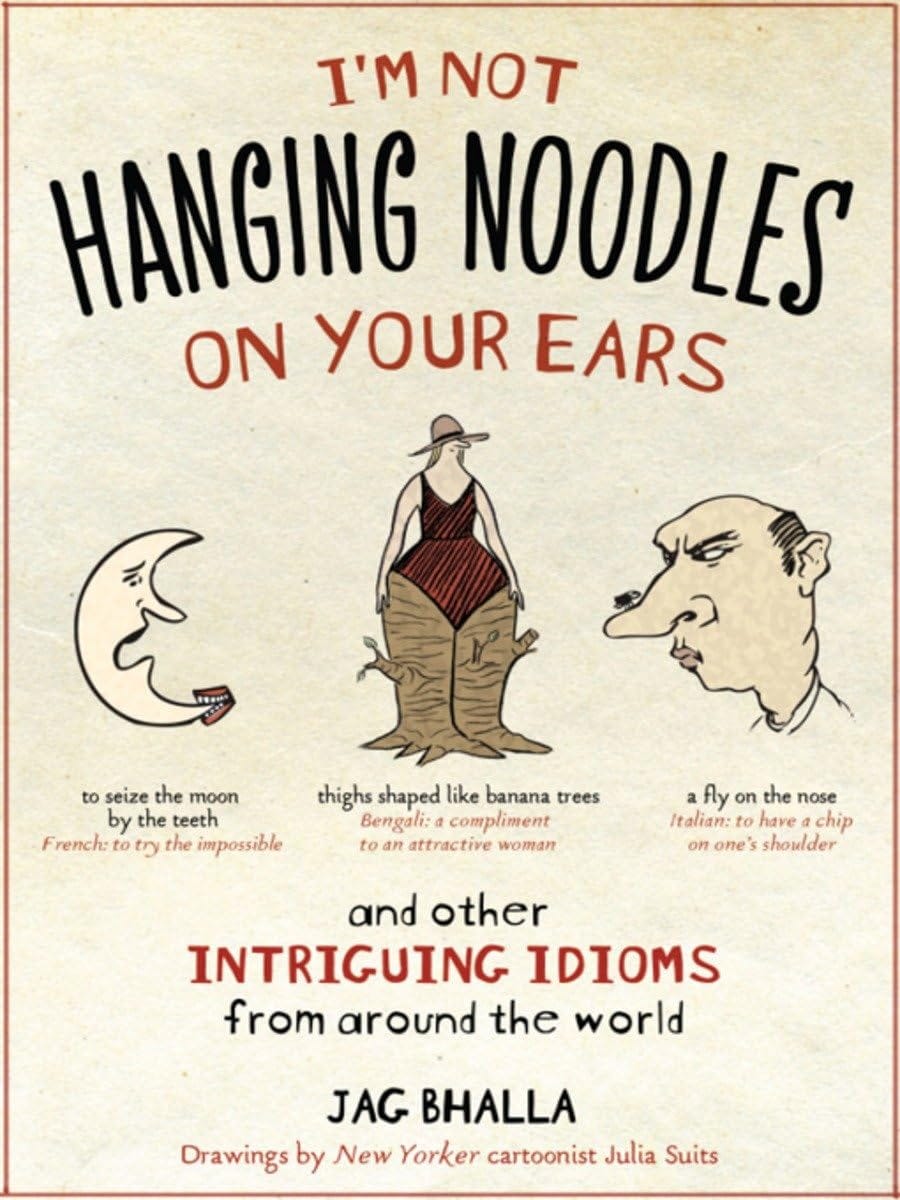
The following are a few of my favorite “intriguing idioms” from around the world:
Lay a rabbit (French) = “to stand up someone” (an idiom in our culture for not showing up for a date or appointment)
Shake the skeleton (Latin American) = “to dance”
A dog and a monkey (Japanese) = “to be on bad terms with each other”
A white crow (Russian) = “a rare find”
Pull the hair out of someone’s nostrils (Japanese) = “to dupe or deceive someone”
A thick stick (Chilean) = “someone important” (a “big shot,” per an English idiom)
Live like a maggot in bacon (German) = “live in luxury”
Bite the moon (French) = “try the impossible” (similar to our “shoot for the moon”)
Grandkids Corner
My grandson, Kolby (13), recently used AI (artificial intelligence) to request something from his parents. Then, he helped our granddaughter, Gabriella (almost 12), ask for something from her parents. These cousins are both pictured below.
Kolby created a video lobbying his parents to let him purchase an e-bike. Yes, he’s the one who fractured his wrist a few weeks ago on a fall from his regular bike. Then, Kolby helped Gabs (as we call her) create a video lobbying her parents to let her get a cell phone. Both Kolby and Gabs emphasized their maturity and responsibility. Both included the rules and safeguards they would put in place to use these devices safely. I watched the videos, and the list of rules they came up with was impressive.
But Kolby’s video requested something else. He was bold enough to ask his parents for a loan to fund part of the cost of an e-bike.
So, how did the parents respond?

Kolby is now the proud owner of an e-bike, and Gabriella has a cell phone! Their parents added a couple additional stipulations, but they were impressed with the content and presentation of both requests.
However, Kolby is learning something about indebtedness. He has to use half of any money he earns to pay down his e-bike loan. He is savvy, though. Recently, his mom gave him $20.00 to purchase something for her at a local grocery store. There was $13.00 in change, and Kolby asked if it could be applied to his loan. This request was turned down.
There is a bright side to this for Priscilla and me—the grandparents. We see Kolby more often now that he has an e-bike to make the “long” nine-block trip from his house to ours. And he has asked if we have any paying jobs. So we will likely see more of him this summer than usual. We might even hear from Gabs more often now that she can text us. However, she may be too busy calling and texting her cousin, Miles (Kolby’s brother). Gabs and Miles recently completed fifth grade at different grade schools, and they will attend middle school together in the fall.
Anyway, it’s fun to watch our grandkids grow up and to see how they “handle” their parents!
Thanks as always for reading my weekly letter. Have a good weekend!
Happy anniversary!! I hope you two had a wonderful day together that you two were with the angels (French idiom for in 7th heaven 😁)