
Steve's Weekly Letter
Thursday, July 30, 2026


One can never take enough photos of Mount Hood, right? I took this photo two weeks ago from the Willamette National Cemetery on Mount Scott near Portland, Oregon.
Reflection
The Bible clearly contradicts itself in 1 Samuel 15. Or so it seems.
Twice the narrator says that the LORD regrets (verses 11 and 35), and twice he says that the LORD does not regret (verse 29). The Hebrew word is the same in all four instances.
It is easy to overlook this apparent contradiction since most English versions translate the Hebrew word in verse 29 as “change his mind.” However, the ESV uses “regret” in each instance.
“I regret that I have made Saul king, for he has turned back from following me and has not performed my commandments.” (verse 11; the LORD is speaking here to the prophet Samuel)
“And also the Glory of Israel will not lie or have regret, for he is not a man, that he should have regret.” (verse 29; the prophet Samuel is speaking here to King Saul)
And the LORD regretted that he had made Saul king over Israel. (verse 35; this is the narrator’s statement—the final statement in the narrative)
A Proposed Solution
What do we make of this apparent contradiction? A good place to begin is to recognize the obvious: the biblical writer is not stupid. The entire book of Samuel, as well as this chapter, is full of literary artistry. If a statement appeared in chapter 2 about God not regretting and another appeared in chapter 30 about God regretting, then we would have more reason for suspicion. But it is inconceivable that a writer would make contradictory statements so close together.
The solution is to understand that the writer used the term “regret” in two different ways in 1 Samuel 15—in an absolute sense and in a relational or emotional sense. Theologian Bruce Ware makes the same point when he describes the verbs “regret” in 1 Samuel 15 being used in a ‘stronger’ sense and a ‘weaker’ sense.
The Absolute Sense
I believe the prophet Samuel uses the verb “regret” twice in an absolute sense in verse 29. He is speaking about God’s character—fundamentally, what God is like. Notice that the first instance of the verb is used in parallel with “will not lie.” God will not go back on his word. The implication is that he will not second-guess his decisions, as if he could have made better ones.
Bruce Ware comments: “God’s knowledge is fixed and he cannot ever find out something that will cause him to second-guess, to question, or to regret what he has done.”
The statements that God does not “regret” reflect his constancy. In Malachi 3:6, God says: “I the LORD do not change. So you, the descendants of Jacob, are not destroyed.” James 1:17 says that God the Father does not change like shifting shadows. Likewise, Hebrews 13:8 says that Jesus Christ is the same yesterday and today and forever.
So then, the prophet Samuel’s statements about God not regretting in 1 Samuel 15:29 reflect the Bible’s emphasis on God’s constancy—the fact that he does not change.
The Relational or Emotional Sense
However, the statements about God regretting in 1 Samuel 15:11 and 15:35 occur in a relational or emotional sense. While God does not question what he has done or second-guess himself (“regret” in an absolute sense), he can still be dismayed or sorry over his choice of Saul as king due to Saul’s disobedience.
I believe the way the two statements about God not regretting (in verse 29) are sandwiched between statements about God regretting (in verses 11, 35) signal to us that we should view them as interpreting each other. The statements are not contradictory. Rather, they hold together in tension.
Establishing Precedent
There is precedent for statements which hold together in tension.
For example, consider the two back-to-back statements in Proverbs 26 about responding to fools:
     Do not answer a fool according to his folly,
           or you yourself will be just like him. (Proverbs 26:4)
     Answer a fool according to his folly,
           or he will be wise in his own eyes. (Proverbs 26:5)
Some scribes wondered whether the book of Proverbs was truly Scripture based on this apparent contradiction. But upon further reflection, they realized that the writer was placing these side-by-side to make a point. The tension between the two is deliberate. Sometimes, wisdom calls for not answering a fool, but sometimes it does. The point is: know your fool and know the situation.
Another relevant example is Exodus 20:20. When God’s people stood at the base of Mount Sinai and witnessed thunder, lightning, a trumpet sound, and smoke, they were afraid. They trembled and stayed at a distance, asking Moses to speak lest the voice of God causes them to die. In response, Moses said: “Do not be afraid. God has come to test you, so that the fear of God will be with you to keep you from sinning” (Exodus 20:20).
The verb be afraid and the noun fear are from the very same Hebrew root word. Thus, Moses says: “Don’t fear, but God has come to test you so that you will fear.” Once again, this is a tension rather than a contradiction. There is a sense in which God doesn’t want us to fear him. We need not run for cover out of sheer terror. However, we should have an awe and reverence that leads us to obey him.
Conclusion
Several years ago, I asked a valued staff member to step down from his role in a church where I served. I do not regret that decision. But I regret having to make that decision, because decisions like that always cause pain.
That’s how we are to understand the descriptions in 1 Samuel 15 over the way that God regrets and does not regret. He enters into relational sorrow over the decisions he makes. Yet in an absolute sense, he does not second guess those decisions.
As the old hymn says, “Thou changest not, Thy compassions they fail not. As Thou has been, Thou forever will be.”
Next week, I’ll tell you the story of the voice that saved a future king’s career. It also appears in the book of 1 Samuel (any guesses?).
Personal Update
Priscilla and I are on the road again. We started our drive to Montana this morning. I’m one of the speakers (along with my son, Luke) at a family camp next week at Clydehurst Christian Ranch south of Big Timber. But we’re not going to take a direct route to get there. What fun would that be? Instead, we plan to stay in Cody, Wyoming tomorrow (Friday) night and then drive through parts of Yellowstone National Park early on Saturday morning before tourist traffic gets heavy. I’m not preaching anywhere this Sunday. We’ll visit a church somewhere before we arrive at Clydehurst on Sunday afternoon. Next week, Luke and I plan to work through the book of Revelation in our chapel sessions (two each day).
The book I’m reading this week is All Things New: Revelation as Canonical Capstone by Brian J. Tabb. It is part of the ‘New Studies in Biblical Theology’ series edited by D. A. Carson. You can view the book here.
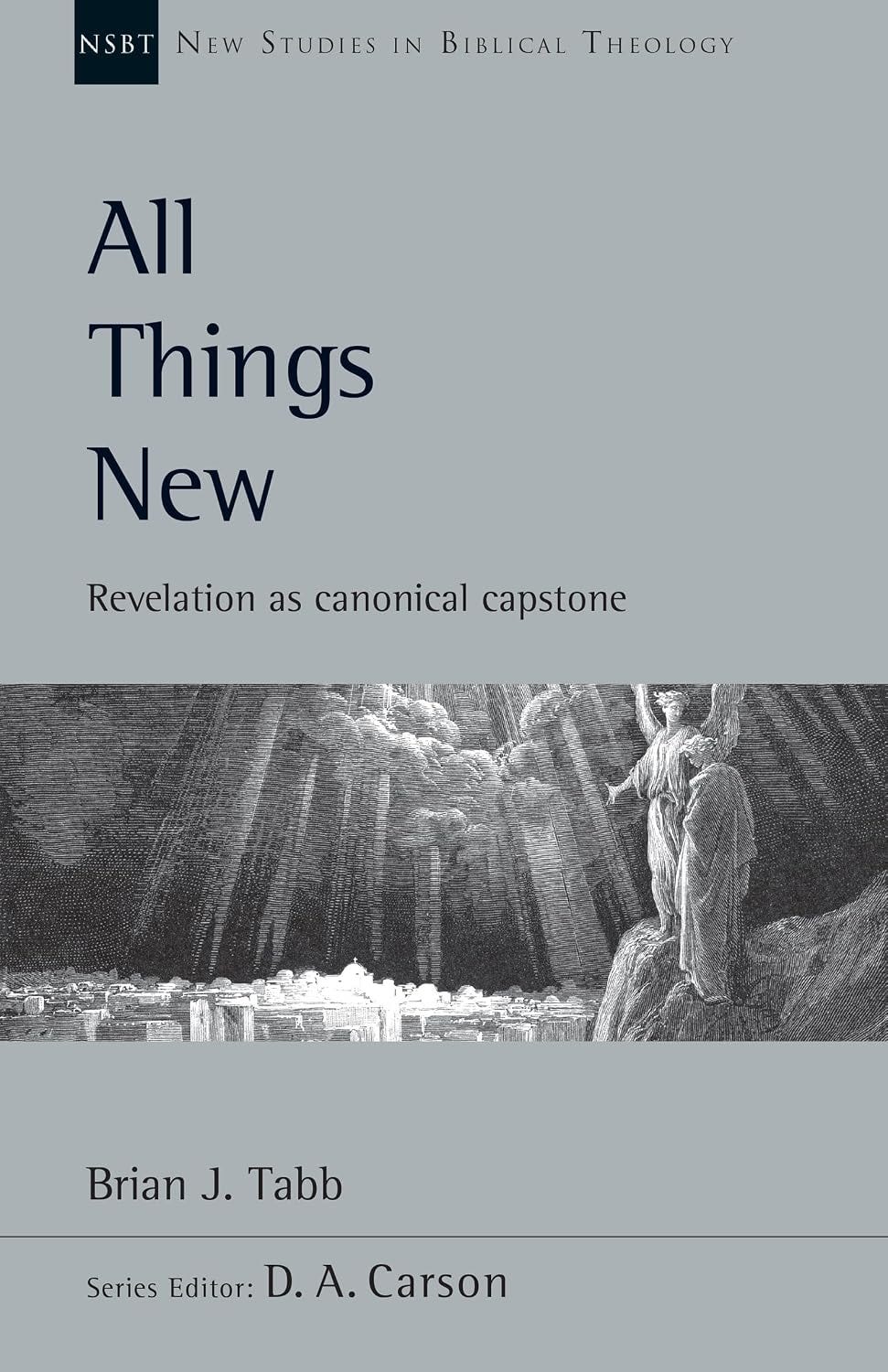
This is an excellent, sensible study of the book of Revelation that works through the book by highlighting its major themes. If you are a pastor getting ready to preach Revelation, I highly recommend it—although my favorite is still The Theology of the Book of Revelation by Richard Bauckham (here). Tabb’s book is aimed at scholars and pastors, yet it’s well-written enough that you might find it helpful even if you have little or no background in biblical studies. It’s often better to read books that are a level above us and stretch us a bit.
However, there are some excellent volumes on Revelation that might be a bit more entry level or user-friendly. My two favorites are Reading Revelation Responsibly by Michael J. Gorman (here) and A Companion to the Book of Revelation by David L. Mathewson—my brother (here).
Grandkids Corner
Our grandson Jameson (4) always has a big smile, but he also torments his family at times—whether by himself or with his twin sister, Mila (pictured with him below left).

The other day, he was playing in their back yard, and his dad was sitting in an Adirondack chair by their fire pit. Jamo and his siblings were throwing water balloons at each other. For whatever reason (perhaps because he is a boy), Jamo filled a bucket with water, snuck up behind his dad, Manny, and dumped it on his dad’s head! Manny is not one to get mad, but he did not appreciate Jamo’s surprise attack.
The Saturday prior to this, Manny went golfing with a friend. He asked Gabriella (12 and pictured above on the right) to help watch the twins—Jameson and Mila—so that Gabriella’s mom—our daughter, Erin—could get some work done around the house. Gabriella recently got a cell phone, and she put it to use that Saturday. The twins were a handful that day. So Gabs kept checking his location, and when he wasn’t moving around the golf course as fast as she hoped, she texted him and said: “Dad, when are you coming home? I need you now. The twins are a disaster!”
There’s never a dull moment with Jamo—for better or for worse.
Thanks as always for reading my weekly letter. Have a good weekend!
Your grandchildren are the very definition of cute!!!! Also appreciate your piece this which came first- but, well, grandchildren are just so adorable!