
Steve's Weekly Letter
Thursday, July 16, 2026


This antique fire engine caught my eye last month at the annual Libertyville Days parade. It appears to be an American LaFrance pumper from 1925.
Reflection
When I lived in Montana, the surnames of Native Americans fascinated me.
I watched a lot of high school basketball games and served as the public address announcer for at least two hundred of them. Whenever teams from Native American communities took the court, the starting lineups included names like Tawny Whistling Elk, Jonathan Takes Enemy, Staci Big Hair, and Elvis Old Bull.
These names reflect either the circumstances attending the child’s birth, a skill the child will hopefully model, or an animal admired for its swiftness or strength.
Old Testament names fascinate me too.
Names like Hannah, Nabal, Micah, and Isaac play a role in Old Testament narratives—that is, the historical accounts in the Old Testament that we refer to as “Bible stories.” As Old Testament Scholar Jean Louis Ska explains, “A very common way to ‘characterize’ a person is to give him or her a name.”
How Names Work in Old Testament Narratives
These names work in a variety of ways—highlighting character qualities, forming puns, and creating irony.
Hannah takes the stage in 1 Samuel 1. Her name means “grace” or favor.” As the story begins, we find her dismayed because she was childless and because her husband had another wife, Peninnah, who had children and kept provoking Hannah in order to irritate her (1 Sam. 1:6). Yet the LORD shows great favor to Hannah, and she gave birth to a son—Samuel, the future prophet who eventually anointed David as king.
Nabal appears in 1 Samuel 25, and his name means “fool.” It’s hard to imagine a mother giving her child this name, so I suspect he earned it. Perhaps no one called him “Fool” to his face. But the Bible tells us he was “surly and mean in his dealings ” (1 Sam. 25:3). When he rebuffed David’s graceful and reasonable request for some supplies—after David and his men had provided protection for Nabal’s shepherds, Nabal almost lost his life. David was ready to kill Nabal until Abigail intervened. By the way, the LORD took care of Nabal in his own way!
In Judges 17, we meet a man named Micah—that is, “who is like Yahweh?” The name is ironic because Micah is nothing like Yahweh! He turns out to be an idolater who tries to build his own “house of God.” This latter act violated Deuteronomy 12:4-7, which called for one central place of worship in Israel.
Then there is Isaac, the long-awaited son promised to Abraham and Sarah. His name is the Hebrew word for laughter. God told Abraham to name his son “Laughter.” I imagine that every time Abraham and Sarah called for Laughter to come to supper, they remembered how they had laughed in disbelief at God’s promise (see Gen.17:17; 18:10-15). Yet this turned into the laughter of Joy when Isaac was born (Gen. 21:1-7).
Names in the book of Ruth
The book of Ruth is especially remarkable in the the story turns on the meaning of the characters’ names. Here is a brief rundown.
The story begins when My God is King (Elimelech) abandons the land of Yahweh, his king, because of a famine and goes to live in Moab—among a people with whom the Israelites were forbidden to associate. He takes his wife, Pleasant (Naomi), and his two sons, Sickly (Mahlon) and Failing (Chilion). These names likely reflect their condition due to being born during a famine.
Eventually, My God is King and his two sons die. His wife, Pleasant, decides to return to Israel, and one of her daughters-in-law, Friendship (Ruth) insists on returning with her. By the way, it’s possible that “Ruth” means Refreshment. Either way, she lives up to her name. But when Pleasant returns to Bethlehem (a city whose name means house of bread), she responds angrily to the women who call out her name when they recognize her. She says” Don’t call me Pleasant. Call me Bitter (“Mara”) because Shaddai has made me extremely bitter.”
To make a longer story short, Friendship’s faithfulness leads to an encounter with Swift Strength (Boaz), who ends up being the kinsman-redeemer who provides for Pleasant as well as for Friendship. But this only happens after Mr. So and So, another potential kinsman-redeemer with first rights of refusal, refuses the opportunity. Yes, the Hebrew expression is designed to withhold the name of this man as an implied expression of judgment on his for refusing to serve as kinsman-redeemer for Naomi and Ruth.
Where to find the meaning of Old Testament names
This all sounds fascinating, but where do you find the meaning of Old Testament name without having to learn Hebrew (the language in which the Old Testament was written)?
A good study Bible will sometimes tell you the meaning of a character’s name when it has a bearing on the story. A good commentary is even more likely to do this for you since it will probably go into greater detail than your study Bible.
You can even ask AI—Claude or ChatGPT. But use AI with caution. Provide a good prompts like: “What do Old Testament scholars say that the name Hannah means in 1 Samuel 1?” But remember the caution offered by Abraham Lincoln, who said: “Don’t believe everything you see on the internet.” Okay, Lincoln didn’t actually say that. But he should have!
Also, keep in mind that not every name has significance in the story. For example, Hannah’s rival in 1 Samuel 1 is named Penninah. It probably means “coral” or “pearl”—thus describing her as precious or valuable. Yet there doesn’t seem to be any significance to her name in the narrative.
With these cautions in mind, pay attention to the names in Old Testament stories. The writer might be highlighting a character quality, forming a pun, or creating irony. Perhaps that will play a part in helping you understand what God is saying.
Personal Update
Today I am wrapping up the four-day doctoral class I’ve been teaching at Western Seminary in Portland, Oregon. The class is on “Preaching 1 and 2 Samuel.” It’s the next-to-last class for a group of doctoral students in a cohort on Transformational Preaching. I fly home tonight.
Then, tomorrow, Priscilla and I are driving to Denver for a wedding reception and a few days of vacation with family. Thus, I will not be preaching anywhere this Sunday.
This week I’ve been reading The Message of Samuel by Mary J. Evans. It is part of “The Bible Speaks Today” series. I highly recommend this little volume if you plan to study or teach the Old Testament books of 1 & 2 Samuel. You can view Evans’ book here.
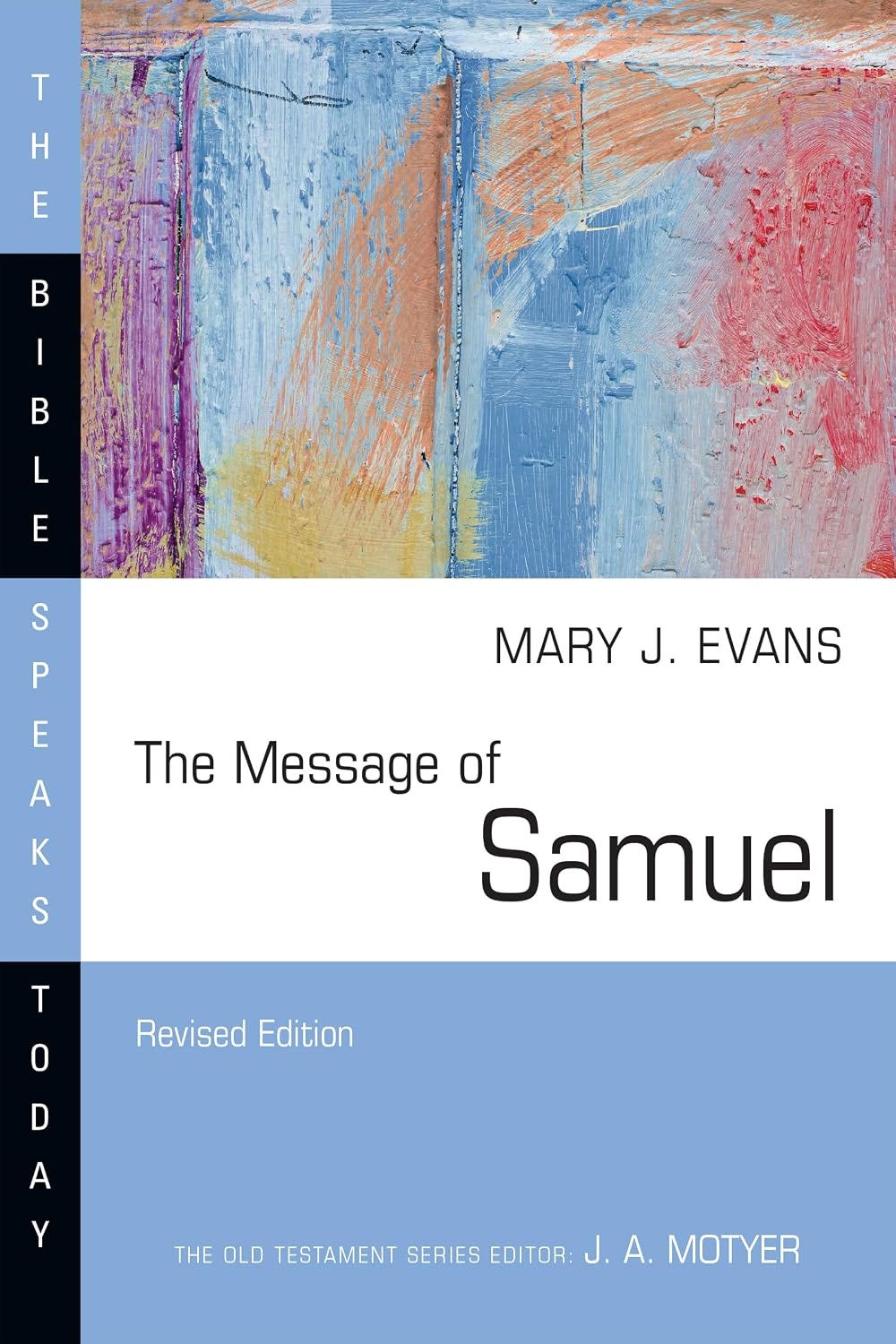
By now, you can detect a theme for this week. What I’ve been thinking about and reading about is Old Testament narrative—and specifically the book of Samuel (originally one book in the Hebrew Bible). Although this is an “entry level” kind of book and accessible to anyone, it’s also a great place for pastors to start. So whether you are new to the Bible or an experienced student or teacher of the Bible, this is a great place to start if you plan on reading, studying, preaching, or teaching the books of 1 & 2 Samuel.
Grandkids Corner
Our grandson Miles (11) purchased an e-scooter. He had saved enough money for half of it. His parents loaned him the other half so he could enjoy it this summer. He is a hard-working, trustworthy kid, so they had no worries about him paying it off by the end of the summer.

The other night, he sat on their bed and said, “Do you think I should have bought the scooter?”
His parents said, “Do you like it?”
“Oh yes, I love it,” he replied. Then he started to cry. When his parents asked him what was the matter, he said: “I just don’t like being in debt.”
His parents reminded him that he is a hard-worker and will easily pay it off by the end of the summer. But I love his aversion to being in debt! It will serve him well in the future.
Thanks as always for reading my weekly letter. Have a good weekend!
Fun post! I’ve thought a bit about the meaning of OT words/names as my first daughter is named Navia (Hebrew: prophetess) and second daughter Selah (nuance of meaning debated, but most agree it’s a liturgical note encouraging a pause, reflection or crescendo of some sort).