
Steve's Weekly Letter
Thursday, May 14, 2026


The Driftless region in southwest Wisconsin and southeast Minnesota does not have the grandeur of the Rocky Mountain West, but it has its own beauty. I fly fished on this little stream near Coon Valley, Wisconsin, a couple weeks ago as the evening shadows began to fall. The Driftless has spring creeks in dells (valleys) that did not get flattened due to glacial drift.
Reflection
Today is Ascension Day.
It falls on the fortieth day after Easter and is the day when the church commemorates the ascension of Jesus to heaven.
Acts 1:9 says that he was taken up before their very eyes, and a cloud hid him from their sight. Two angels told his disciples that Jesus was “taken into heaven” (Acts 1:11).
What is the significance of the ascension of our crucified and risen Lord?
Theologian Michael Horton observes that we typically “treat the ascension as little more than a dazzling exclamation point for the resurrection rather than as a new event in its own right.” Yet the ascension is a key part of the story of God redeeming people from their sins to life in his presence.
Here, then, are five ways that the ascension of Jesus benefits us, his followers.
1. It establishes Jesus as the reigning king over all other powers and in all ages
Ephesians 1:20-21 speaks of the power that God exerted when he raised Christ from the dead and seated him at his right hand in the heavenly realms, far above all rule and authority, power and dominion, and every name that is invoked, not only in the present age but also in the one to come.
For this reason, the Apostle Paul can call us a few chapters later to take our stand against the devil’s schemes (Ephesians 6:11). It is the Lord’s mighty power that makes this possible (Ephesians 6:10), and it is a power we can access as believers who have been seated in the heavenly realms with our ascended Lord (Ephesians 2:6). We need this power because the problems we face in the church that appear to be mere human conflicts are really struggles with the forces of darkness (Ephesians 6:12).
2. It gives us access to God’s throne to get the mercy and grace we need
In the person of Jesus we have a great high priest who has ascended into heaven (Hebrews 4:14). A more literal rendering of the NIV’s “ascended into heaven” is “passed through the heavens.” This, of course, is the language of ascension. Jesus passed through the heavens to be seated at God’s right hand (see Hebrews 1:3).
The result is that we can approach God’s throne of grace with confidence, so that we may receive mercy and find grace to help us in our time of need (Hebrews 4:16). Whether we are battling cancer, bitterness, betrayal, pride, or discouragement, we can pray with confidence because of our ascended Lord who intercedes for us.
3. It provides us with an Advocate here on earth—the Holy Spirit—whose presence is unlimited
The night before he was crucified, Jesus promised his disciples that he would “ask the Father, and he will give you another advocate to help you and be with you forever—the Spirit of truth” (John 14:16-17a). Later, he returns to this theme and says: “But very truly I tell you, it is for your good that I am going away. Unless I go away, the Advocate will not come to you; but if I go, I will send him to you” (John 16:7).
But what advantage would this create for the disciples? Jesus is the one they followed and loved. Why would they want to see him leave so that the Spirit could come? It almost sounds like a parent saying to their children, “It’s better if I leave you so that my cousin can come and take care of you.” How is Jesus’ leaving an advantage for the disciples?
The answer is simple, yet profound. The incarnate Jesus was limited by space and time. He could not be with every one of his followers at once. If Jesus had stayed on earth, he could not have been there for Peter in Rome and for John on the island of Patmos at the same time. But the Holy Spirit can! His empowering presence is available to all followers of Jesus at the same time and in all places.
4. It enables us to receive the spoils of Christ’s victory—gifted leaders and spiritual gifts
In Ephesians 4:7-12, the Apostle Paul connects the grace we have received in Christ with the ascension. This grace is a reference to the spiritual gifts which Paul describes elsewhere (see 1 Corinthians 12) and to the gifted ministers of the Word which he describes here in verse 11. Paul makes the connection by quoting Psalm 68:18, a description of God’s triumphal ascension to his throne after leading his people out of Egypt and into the land of Canaan.
So we share in Christ’s heavenly triumph by receiving its benefits—specifically the gifts and gifted leaders needed for building up the church in unity and maturity.
5. It keeps us longing for his return
At Jesus’ ascension, the two angels declared: “This same Jesus, who has been taken from you into heaven, will come back in the same way you have seen him go into heaven” (Acts 1:11). So the ascension creates a longing for Jesus’ return. It reminds us that Jesus’ reign is “already, but not yet.” He is presently seated at the right hand of the Majesty in heaven (Hebrews 1:3). Yet Jesus will eventually return earth to establish his kingdom in all of its fullness and to put his enemies under his feet (see 1 Corinthians 15:24-27).
Forget not all his benefits
Jesus’ ascension was not merely an exclamation point at the end of the resurrection. It provided his followers with the power, grace, mercy, presence, gifts, and anticipation which enabled them to continue His mission.
On this Ascension Day (forty days after Resurrection Sunday), take time to reflect on how Jesus’ ascension, as well as his resurrection, changed everything. Respond to the psalmist’s call to “forget not all his benefits” (Psalm 103:2). Some of the most remarkable benefits provided by God come to us directly as a result of Jesus’ ascension to the right hand of the Majesty in heaven.
Personal Update
This week I am in Lake Geneva, Wisconsin at a preaching seminar with about 25 other pastors from around the United States and Canada. This is an annual seminar that my mentor, Haddon Robinson, began 26 years ago. I have been a participant for the past 24 years. Now, the seminar operates under the Didasko Seminars. The found of Didasko, Chris Dolson, and I co-lead the preaching discussions. This year, we invited Dr. Michelle Knight, an Old Testament professor at Wheaton Graduate School, to teach on the book of Joshua. It’s great to have my son, Luke, with me. He is a pastor in the southwest suburbs of Denver.
This Sunday, I plan on preaching Ephesians 2:1-10 at the Evangelical Free Church of Des Plaines, where I serve as interim pastor. The title of the sermon is “God’s Grace and the Story of Your Rescue.”
The book I am reading this week is Last Branch Standing by Sarah Isgur. As the subtitle says, it is “a potentially surprising, occasionally witty journey inside today’s Supreme Court.” You can view the book here.
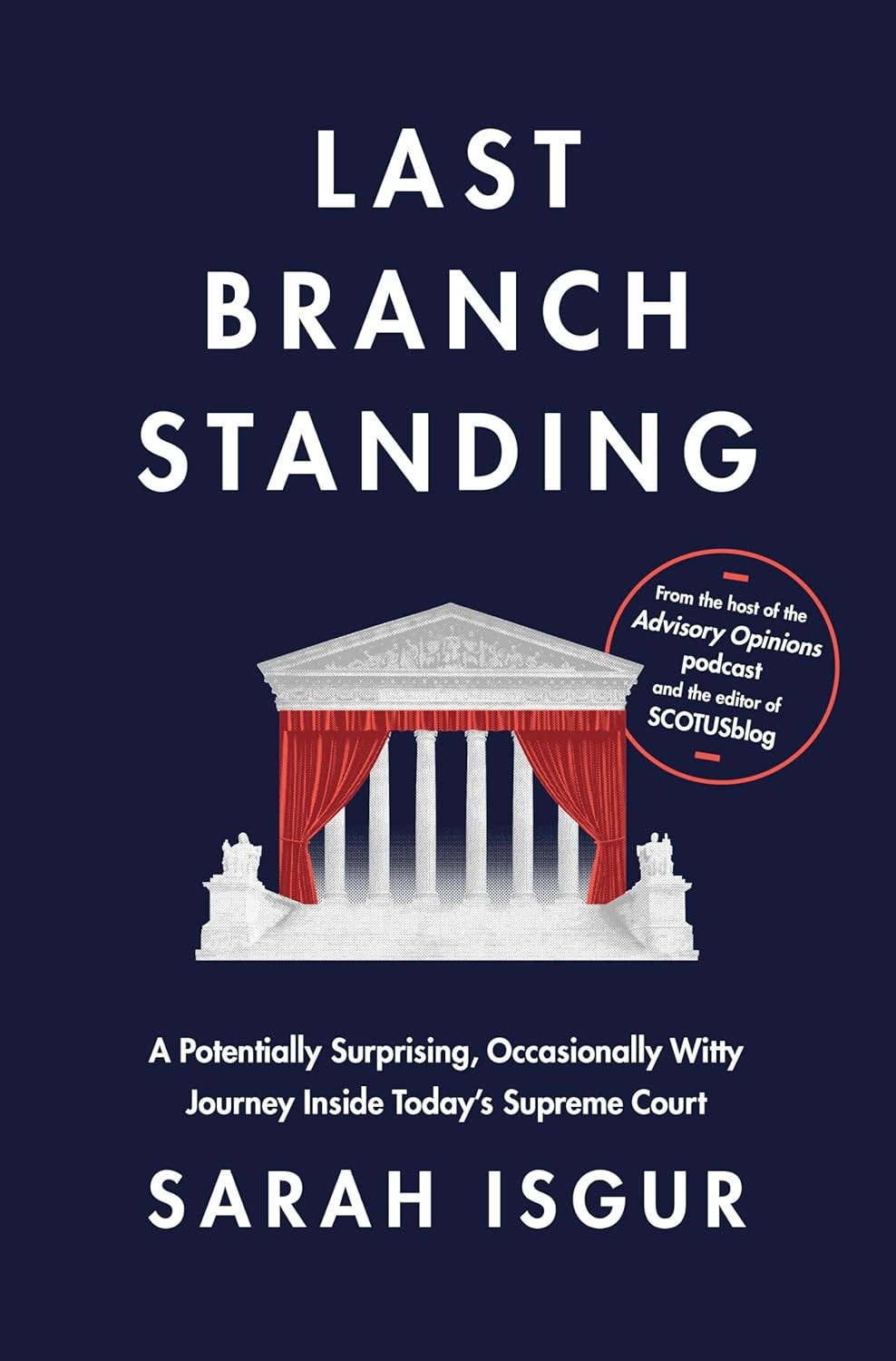
Sarah Isgur argues that most people—including the media—get the Supreme Court wrong. They are shocked when conservative justices side with rulings that seem politically liberal or when liberal justices vote for rulings that seem politically conservative. Isgur argues that there is another factor besides partisan politics. Supreme Court justices also decide on the basis of “institutionalism.” Three justices who happen to be political conservatives—Kavanaugh, Roberts, and Barrett—are more institutionalist than the other six. They value precedent and worry about institutional credibility and consistency. The remaining six justices—the political conservatives (Alito, Thomas, Gorsuch) and the political liberals (Kagan, Sotomayer, Jackson)—are less institutionalist. They contend that the law is what it is, so correctly deciding a case is more important than precedent. This explains why the court is more of a 3-3-3 split rather than a 6-3 majority in favor of political conservatives. If you’re interested in how the Supreme Court works and a little bit about the justices who serve on it, then you’ll enjoy this book.
Grandkids Corner
On Mother’s Day evening, Priscilla and I participated in another epic kickball battle between the kids (our grandkids) and the adults (our children and their spouses). After two bitter losses by the kids (yes, they cried and complained on both occasions), they were hoping for victory. Our grandson Madden (almost 10) is so invested in this annual event that he used his own money to buy a kickball for it. Perhaps you can tell who won by the reaction of the two grandkids who are pictured below—cousins Miles (11) and Gabriella (almost 11 1/2).

Yes, the kids hung on to win 31-25. You would have thought they won the World Series with all the screaming that took place. Miles (as you can see from the above photo) yanked off his shirt and was flinging it around as he ran around the yard.
I have to say that the adults were more gracious in defeat than the kids were in their previous two losses. However, the adults had as many excuses as the kids. “We were missing Ben, Nicole, and Grant. If they had been here, we definitely would have won.” Maybe. But our grandkids are getting bigger and stronger. Meanwhile, the oldest two members the adults’ team (that would be me and Priscilla) are showing their age. I’m happy to report that I kicked the ball off of the back fence twice, narrowly missing home runs on both occasions. But my defense was so bad that Priscilla accused me of trying to help the kids team. If only that were true! The reality is, I don’t move like I used to when I was younger.
One of the adults summed up our biggest regret in losing to the kids: “We’re never going to hear the end of this—at least until the next time we win.” The question is, will the adults ever win again?
Thanks as always for reading my weekly letter. Have a good weekend!