
Steve's Weekly Letter
Thursday, April 23, 2026


Last Friday was a beautiful day in the Columbia River Gorge just east of Hood River, Oregon. I took this photo while hiking on the Historic Columbia River Highway State Trail near the Mosier Twin Tunnels. The island is Eighteenmile Island.
Reflection
The Apostle Paul says in 1 Corinthians 15:44 that our natural body will be raised as a spiritual body. Does this mean our resurrection body will not be a physical body?
No! Paul is not denying that the resurrection body of a believer in Jesus will be a physical body. He is claiming something else.
Natural vs. Spiritual
In 1 Corinthians 15:42-49, Paul develops a claim based on his observation that when you sow, you do not plant the body that will be, but just a seed (15:37). His claim is that like a seed that grows into something quite different, the resurrection body is quite different than the body that is buried in the ground when a person dies. This is what happens to your body when you die:
It is sown perishable, it is raised imperishable (42)
It is sown in dishonor, it is raised in glory (43)
It is sown in weakness, it is raised in power (43)
It is sown a natural body, it is raised a spiritual body (44)
Thus, the natural body is what we have now; the spiritual body is what we will have when we are resurrected from death. But what is the difference? I explained this in my book, RISEN: 50 Reasons Why the Resurrection Changed Everything (p. 62):
“The terms natural and spiritual are the same two adjectives Paul used in 1 Corinthians 2:14 to describe the differences between nonbelievers and believers. These terms do not describe the type of material or “stuff” from which the body is made; rather, the natural body is the one that belongs to the life of the present age—the body in the realm of sin, and the spiritual body is the one that wil belong to the life of the future age—the age or realm of the Spirit of God.”
My friend, Patrick Schreiner, puts it this way in his new book, The Hope of the Resurrection, when he talks about our resurrection bodies: “To say they are ‘spiritual’ bodies doesn’t describe their substance but what animates them. We will have bodies governed by the Spirit” (p. 71). Exactly!
The Last Adam
But how can we be sure that this progression from having natural bodies to spiritual bodies is reasonable?
The answer is that it has already happened in human history!
According to 1 Corinthians 15:45-47, the first human being, Adam, had a natural body. His origin was the dust of the earth. The “last Adam,” Jesus Christ, has a spiritual body. His origin is heaven.
Your Spiritual Body
So then, what will your spiritual body be like?
For starters, go back to the list Paul provided in 1 Corinthians 15:42-44. Your spiritual body will be imperishable, meaning that it will never decay. It will also possess a glory and power that will enable us to live life on God’s restored earth—the new earth of Revelation 21:1-22:5.
Beyond the descriptions Paul gives us in 1 Corinthians 15, it seems likely that our resurrection bodies will be able to eat like Jesus did in his resurrected state (Luke 24:41-43). Perhaps we will be able to go through barriers such as doors (John 20:26-27). And even though resurrected people will not marry (Matthew 22:30; Luke 20:35), it is certainly not because our bodies will be less wired for intimacy. Likely they will be able to experience intimacy that far surpasses the sexual intimacy our natural bodies presently can experience.
You will still be you. Or, as Patrick Schreiner says, “We will have our same bodies, but they will be upgraded.”
This is stunning, isn’t it?! We have an amazing life to look forward to in our spiritual bodies, and it’s all because Jesus Christ is risen—he is risen indeed!
Personal Update
I am not preaching anywhere this Sunday, April 26, because I have the privilege of baptizing my two oldest grandsons, Blake (15) and Kolby (13), and a couple of their friends—two sons of some close friends of ours. The baptisms will take place at the 10:30 a.m. worship service at their church—Center Church in Libertyville. I’m so grateful to see these four young men profess their allegiance to Jesus Christ.
The book I’ve been reading this week is A River Runs Through It by Norman Maclean. I pulled this off my bookshelf because this month is the 50th anniversary of the book’s publication in April 1976. You can check it out here.
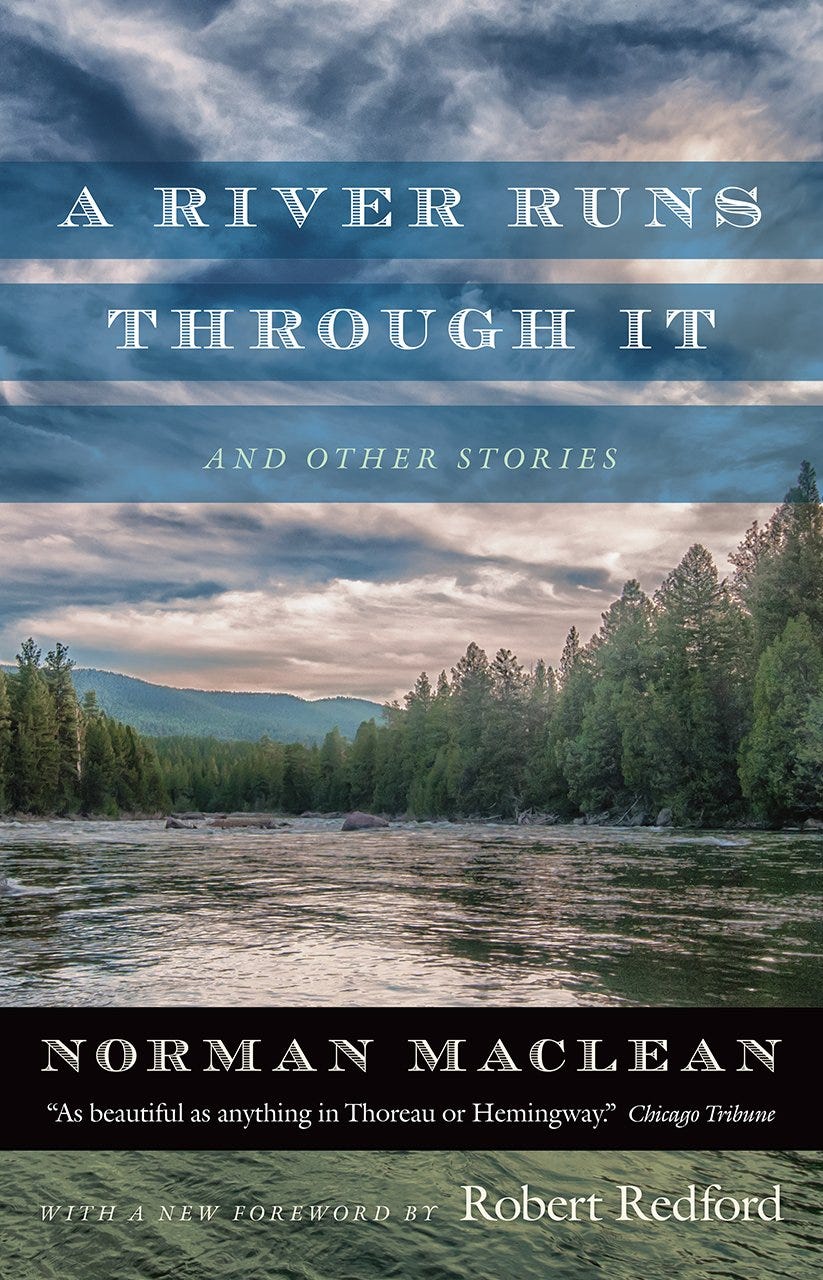
Maclean wrote this novella after his retirement from 45 years of teaching English at the University of Chicago. He was 72 when he sent it to publishers, but it was rejected either because it was too short or because is was “not a saleable book.” Finally, The University of Chicago Press agreed to publish it, even though it was an academic press and Maclean’s novella was a work of fiction—loosely based on his life.
The first time I read this book, while living in Helena, Montana, I was mesmerized by the first paragraph:
In our family, there was no clear line between religion and fly fishing. We lived at the junction of great trout waters in western Montana, and our father was a Presbyterian minister and a fly fisherman who tied his own flies and taught others. He told us about Christ’s disciples being fishermen, and we were left to assume, as my brother and I did, that all first-class fishermen on the Sea of Galilee were fly fishermen and that John, the favorite, was a dry-fly fishermen.
Of course, this book is sad and contemplative (the final sentence reads: I am haunted by waters) as well as a bit humorous. And it contains a somewhat risque scene. It’s also worth pointing out that the fatal beating of Norman’s brother actually took place in an alley not far from the University of Chicago rather than in Montana .
Yet the novella’s message is rather profound. While fly fishing figures prominently in the story, the real message is about people—especially family. As the Rev. Maclean, Norman’s father, observes, “it is those we live with and love and should know who elude us.” Yet, the novella affirms that we can love people completely even though we do not completely understand them.
Grandkids Corner
Our Colorado grandsons Jacob (4 1/2) and Dakota (3) both like snakes—just like their dad, Luke. They find garter snakes near their condo and bull snakes near Bear Creek, which runs behind their condo. Recently, Luke sent a photo of Dak with a bull snake and a video of the boys with a garter snake.
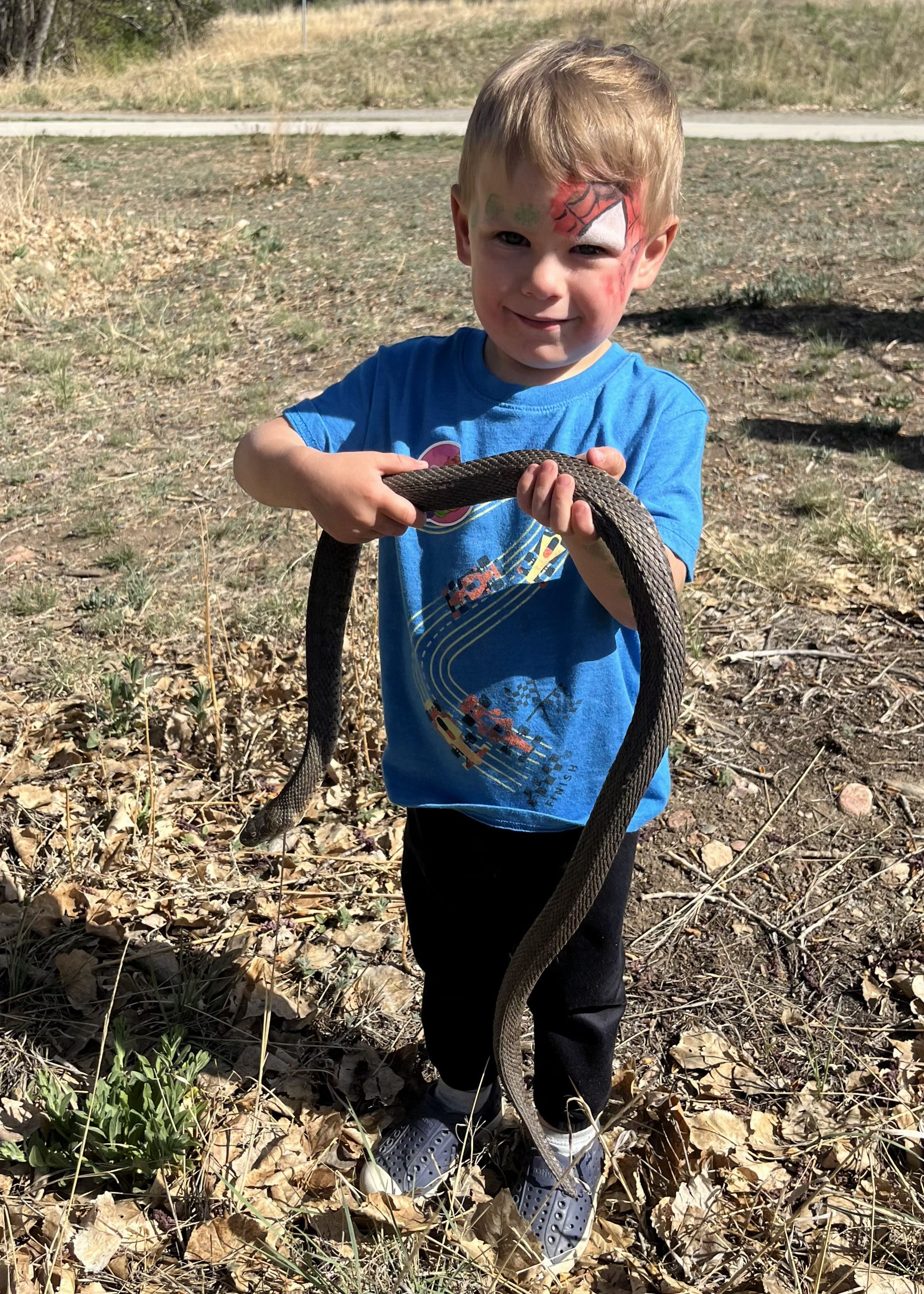
I guess it’s good that the boys have no fear. Their dad, Luke, is a responsible guy, so I know he’ll teach them the rules that gave him when he was a boy growing up in Montana.
Learn the difference between a bull or garter snake and a rattlesnake!
Keep your distance from a rattlesnake.
Never bring a snake inside the house (or inside our church facility)!
Do not terrorize your siblings or parents with the snakes you handle.
And yes, there is a story behind #3!
Thanks as always for reading my weekly letter. Have a good weekend!
Great article. I haven't read the book. Watched the movie because of the filming that took place in the area. Funny part was your comments about the boys and snakes. I hunt rattlesnakes in the summertime. Seems I run into more bull snakes than rattlesnakes. Hope you are well, Steve.